Absolute Silence
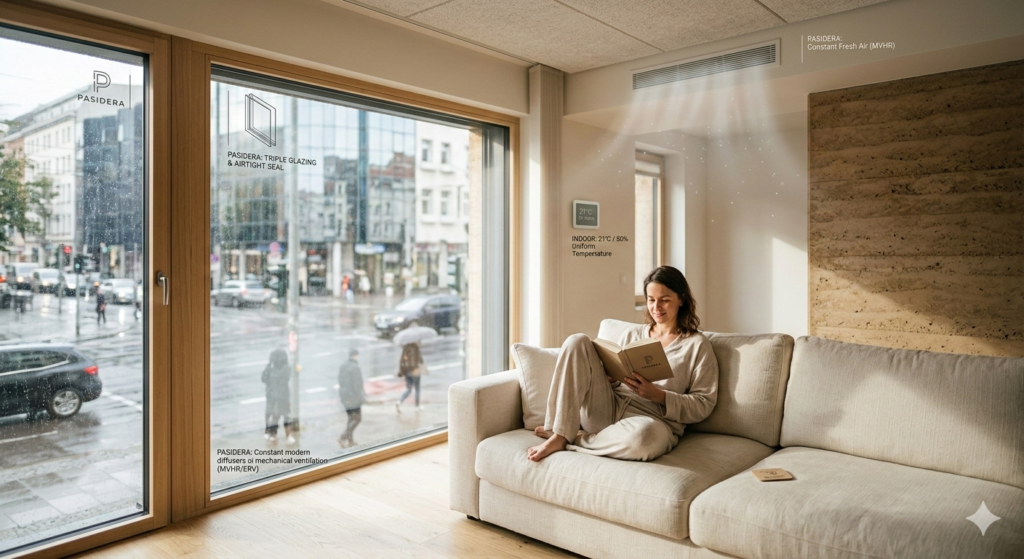
The noise of the street simply disappears. Thanks to high-performance triple-glazed windows and superior insulation, your home becomes a true sanctuary, regardless of the weather outside.
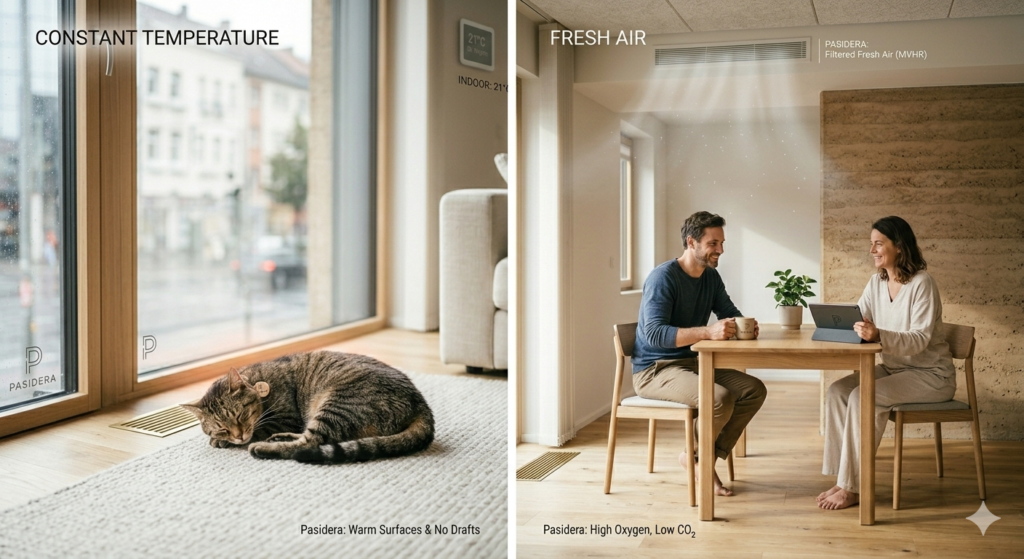
Constant Temperature
No cold spots near windows and no temperature fluctuations. Enjoy uniform thermal comfort in every room, 24/7, without constantly adjusting your thermostat.
Fresh Air, Always
Forget the feeling of stuffy air. The mechanical ventilation system continuously refreshes the air, filtering out dust and allergens, so you breathe clean air every single moment.
In architecture, sustainability, and thermal efficiency, the Passive House (Passivhaus) standard marks the future of modern residential construction. More than just an aesthetic choice, this standard represents a fundamental paradigm shift: moving away from buildings that merely consume resources toward intelligent structures that self-manage their energy needs, providing unparalleled comfort.
Why the Shift is Essential
Beyond energy savings, the Passive House standard redefines the relationship between a building and its occupants. Here is why it is becoming the benchmark for high-performance design:
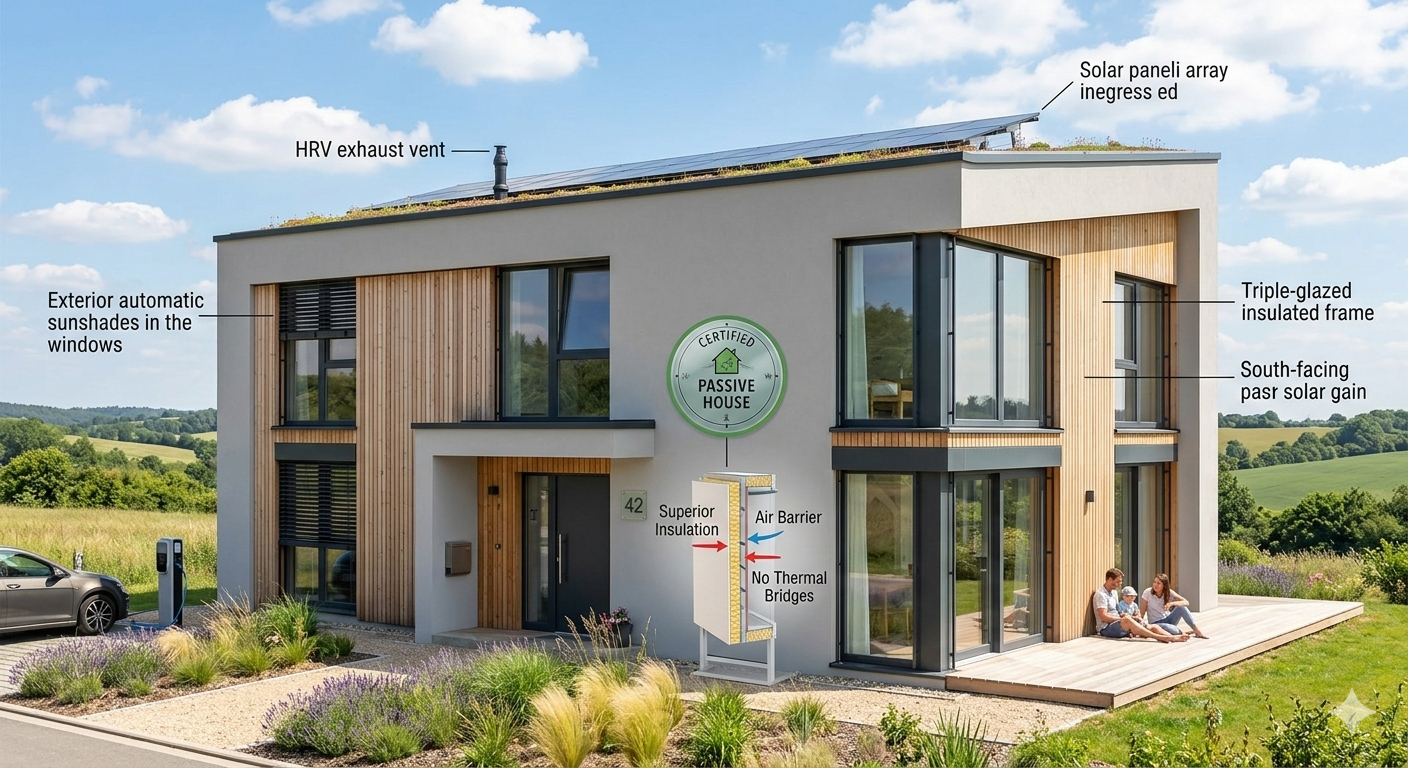
The “Fabric-First” Philosophy: Unlike traditional construction, which relies on adding more complex mechanical systems to fix efficiency problems, the Passive House approach focuses on the “envelope.” By using superior insulation, airtight construction, and high-performance, thermal-bridge-free window assemblies, the building itself does the heavy lifting to maintain an ideal temperature.
Superior Indoor Air Quality (IAQ): A core component is the Energy Recovery Ventilation (ERV) system. It doesn’t just recycle air; it filters out dust, allergens, and pollutants while keeping the heat inside. This makes these homes sanctuaries, especially for those in dense urban environments or those prone to respiratory sensitivities.
Climate Resilience: As the world experiences more extreme weather events, Passive Houses offer stability. Because they are so well-insulated, they can hold their internal temperature for days without any active heating or cooling, providing a crucial safety buffer during power grid failures or heatwaves.
Long-Term Asset Value: A Passive House is effectively “future-proof.” As building codes tighten globally to meet carbon-neutral goals, these homes are already decades ahead of the curve. They are not just buildings; they are resilient, high-equity assets that will remain desirable for generations.
The Bottom Line Choosing to build to the Passive House standard is essentially moving from a "reactive" model of home ownership, where you are constantly fighting against the elements, to a "proactive" one, where the architecture itself works in harmony with the local climate to ensure your comfort.
Why does it cost more upfront, and how do you recoup the investment?
It is important to be candid: a Passive House requires a higher initial investment. Here is where those additional costs go:
Windows and Doors: You need triple-glazed windows and frames with superior thermal insulation properties.
Airtightness: Implementation requires meticulous workmanship and specialized materials (sealing tapes, membranes), which increases labor costs.
Mechanical Ventilation (HRV/ERV): The mechanical ventilation system with heat recovery represents an additional expense that is not found in standard builds.
Design and Engineering: You need an architect and engineer specialized in energy modeling using the PHPP (Passive House Planning Package) software, which comes with professional fees.
How do you recoup the investment?
The 10–15% cost premium is amortized over time through utility bill savings. While a traditional home incurs significant costs for heating and cooling, those expenses are nearly negligible in a Passive House. Furthermore, as energy prices rise, your monthly “savings” continue to grow, making the house an increasingly smart financial decision over time.
An Often Overlooked Factor: The "Hidden" Cost of Comfort Beyond the numbers in the table, you must consider the long-term maintenance costs. In a Passive House, the risk of mold growth or condensation is virtually zero, thanks to the controlled mechanical ventilation system.
| Criteria | Conventional Home | Passive House |
| Initial Costs | Lower (Standard) | 10–15% Higher |
| Operating Costs | High (High utility bills) | Very low (~90% savings) |
| Thermal Insulation | Standard | Advanced (no thermal bridges) |
| Ventilation | Natural (windows/vents) | Mechanical with heat recovery |
| Thermal Comfort | Varies by room | Uniform, constant, no drafts |
| Resale Value | Standard depreciation | High (future-proof) |