
PASIDERA · ARCHITECTURAL ANALYSIS
The Jenga Building: How BU Redefined Campus Architecture on the Charles River
KPMB Architects’ Center for Computing & Data Sciences is not just Boston University’s tallest structure — it is a manifesto for the future of academic building, written in steel, glass, and geothermal ambition.
By Pasidera Editorial · Architectural Analysis
Bostonians crossing the Charles River by foot, car, or the MBTA’s Green Line have grown accustomed to a peculiar silhouette dominating the skyline along Commonwealth Avenue. Stacked and staggered, the tower appears to defy both gravity and architectural convention — its cantilevered volumes jutting in every direction as though a giant game of Jenga had been frozen mid-play. The nickname, coined by commuters and embraced by the press, stuck long before the building was finished. And in a city that tends toward the conservative in its public architecture, that alone signals something significant.
The Boston University Center for Computing & Data Sciences, completed in December 2022 and designed by the Canadian firm KPMB Architects, is the university’s tallest structure and, at 345,000 square feet, its most ambitious single building project in recent memory. But the Jenga Building is far more than a piece of skyline drama. It is a carefully argued position on how a 21st-century academic institution should occupy space, consume energy, and cultivate community — a position worked out over nearly a decade of design development and executed with uncommon rigor.
This analysis examines the building from an architectural standpoint: the formal logic behind the cantilevered massing, the structural ingenuity it demanded, the relationship between form and sustainability, and what the building suggests for the future of campus design.
Project Name | BU Center for Computing & Data Sciences |
Architect | KPMB Architects (Toronto, Canada) |
Contractor | Suffolk Construction |
Height | 305 feet (19 stories) |
Floor Area | 345,000 sq. ft. |
Completion | December 2022 |
Sustainability | LEED Platinum certified (2023) |
Energy System | 31 geothermal wells, 1,500 ft deep |
Award | Best Tall Building – Americas, CTBUH 2024 |
Project data: BU Center for Computing & Data Sciences, opened January 2023.
01 — FORM & MASSING
A Building That Rotates as It Rises
The defining gesture of KPMB’s design is disarmingly simple to describe but extraordinarily difficult to execute: the floor plate rotates clockwise by roughly 23 feet every two to three storeys. As you ascend the 19-storey tower, each successive volume shifts relative to the one below, opening up the roof of the preceding floor to create an outdoor terrace. Repeat this eight times, and you have the Jenga Building — eight green terraces, eight moments of controlled imbalance, eight declarations that the building is in conversation with the sky as much as with the street.
Luigi LaRocca, founding principal at KPMB and project manager for the CDS, described the internal logic: the rotation means the building changes appearance every five feet of height, giving each of the five academic departments housed within a subtle spatial identity of their own. The movement is not arbitrary — it is the architectural expression of an institution that wants to signal, in its very fabric, that knowledge here is not siloed but fluid.
“It gives the departments a little bit of identity, by creating this movement in the building that gives it a dynamic presence.” — Luigi LaRocca, KPMB Architects.
From street level, the effect is dramatic. The transparent five-storey podium — a covered ‘urban porch’ that stretches along Commonwealth Avenue — gives way to a tower that seems to cantilever precariously in multiple directions simultaneously. From the Charles River, the staggered volumes catch light differently depending on the time of day and season. KPMB design lead Paulo Rocha described the mirrored glass as particularly powerful: on clear days, the building appears almost to hover, its upper cantilevers reflecting the terraces below rather than the solid volume you might expect.
02 — STRUCTURAL ENGINEERING
The Architecture of Controlled Imbalance
No building looks like the CDS without a structural argument to match its visual ambitions. The cantilevered design required a close collaboration between two structural engineering firms: Entuitive’s Toronto office, which designed the exposed steel frame, and LeMessurier, a Boston firm with deep roots in the city’s skyline. KPMB described the partnership as a genuinely shared creative process — not an architect instructing an engineer to make a form work, but a dialogue in which structure itself became part of the aesthetic.
Portland cement and steel form the primary structural system. The team achieved a six percent reduction in embodied carbon through what they describe as optimised construction methods, including sourcing steel from production facilities with lower carbon footprints. For a building of this structural complexity — one whose overhanging volumes exert significant lateral and torsional loads — this level of embodied-carbon accounting represents a meaningful commitment to lifecycle thinking rather than merely operational sustainability.
The exposed steel structure is not concealed; it is celebrated. Inside the atrium, a large black steel ramp morphs into a staircase as it rises through eight floors of open space. Rocha refers to this as a ‘ribbon of circulation’ — a continuous structural-and-spatial gesture that draws occupants upward through the building. The choice to leave it exposed and to paint it black — contrasting with light hemlock wood paneling and bright, primary-colored furniture — transforms a piece of structural necessity into the interior’s most commanding visual element.
03 — SUSTAINABILITY
Net Zero as Architecture, Not Afterthought
The environmental credentials of the CDS have received extensive attention, and rightly so: it is the largest fossil-fuel-free building in Boston, LEED Platinum certified, and — as of its completion — the largest geothermal building in a dense urban environment in the United States. But what makes the building architecturally significant from a sustainability perspective is not merely the technical achievement of the geothermal system. It is the degree to which sustainable thinking shaped the building’s form from the outset.
The 31 geothermal wells, each drilled 1,500 feet into the bedrock beneath Commonwealth Avenue, provide the majority of the building’s heating and cooling by exploiting the earth’s relatively stable underground temperature. No natural gas pipes run to the building. Electricity is sourced through a long-term procurement agreement tied to a wind farm in South Dakota, which also reduces BU’s broader campus carbon emissions by roughly 53 percent.
“This building provides a powerful example for ourselves and others for how to build for a carbon-free future. It is a symbol of climate leadership.” — Paulo Rocha, KPMB Architects.
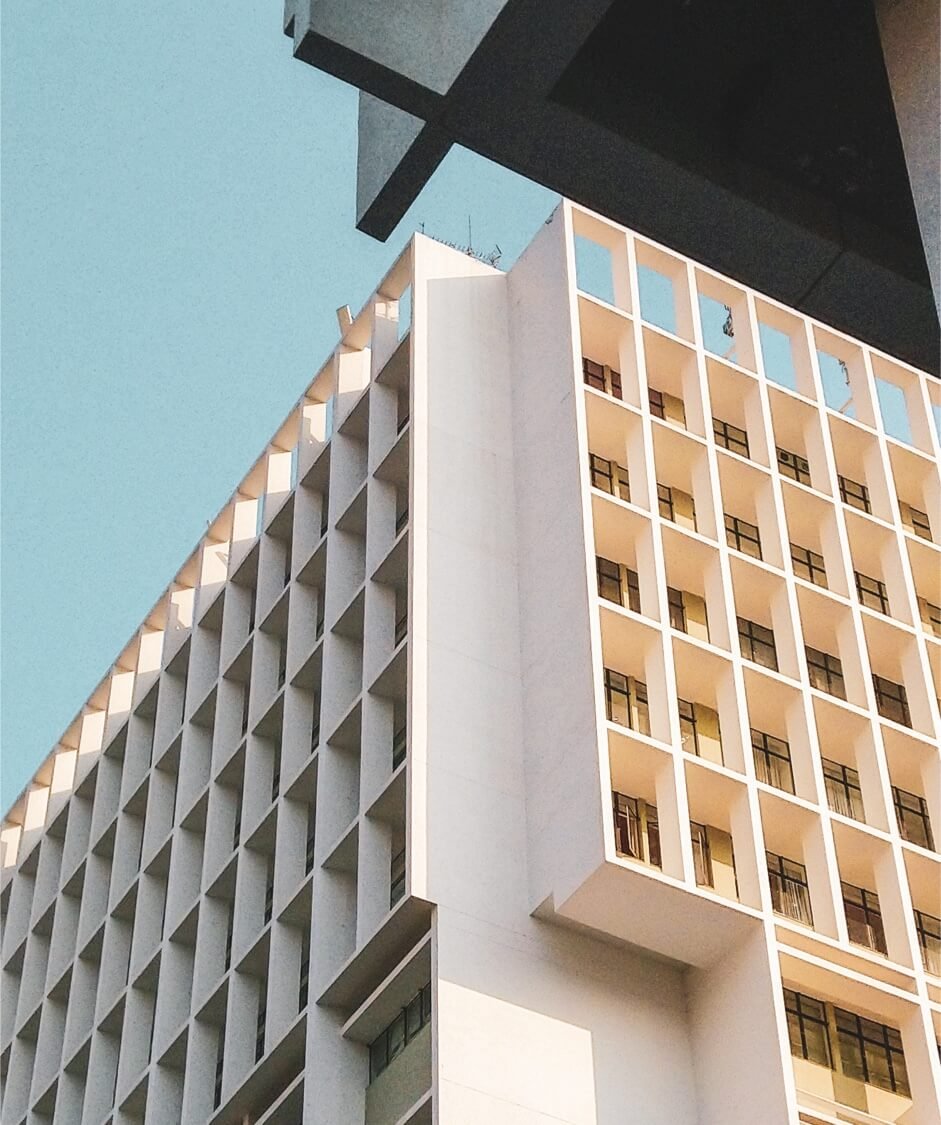
But return to the building’s form: the cantilevered volumes that define its silhouette also create those eight green terraces, each of which functions as a green roof for rainwater retention and thermal regulation. The façade’s angled and diagonal louvers — which give the exterior its distinctive linear texture and a reddish-brown warmth that references the brick row houses of the surrounding neighborhood — are calibrated to the site’s sun patterns. They shade the interior in summer and admit lower winter light, reducing the mechanical load the geothermal system must carry.
Even the famous ‘irresistible staircases’ — open, visually compelling stair runs designed to entice occupants away from the elevators — carry a dual sustainability logic. They promote physical health, yes, but they also reduce elevator energy demand in a building where vertical circulation across 19 floors represents a significant operational load. The building is set three feet above the elevation of the Charles River Dam, a quiet acknowledgment that the infrastructure of today must account for the climate conditions of 2050 and beyond.
04 — URBAN & CAMPUS CONTEXT
The Vertical Campus and the City
BU’s campus is an unusual one: a long, narrow strip of land pressed between Commonwealth Avenue and the Charles River, with no natural center of gravity. The university has historically lacked an iconic building — a moment of architectural confidence that announces itself to the city. The CDS addresses this directly. At 305 feet, it is visible from MIT across the river. Its podium engages the street at exactly the scale of the surrounding low-rise context. And the transparency of that podium — which allows passersby to see students moving through the atrium — enacts a kind of institutional openness that many academic buildings struggle to achieve.
The building’s concept of ‘ascending academic neighborhoods’ deserves particular attention as an urban model. Rather than organizing departments horizontally across a campus — each in its own building, each with its own entrance and identity — the CDS stacks them vertically. Mathematics and statistics occupy the lower floors; computer science, the middle; interdisciplinary work and public space, the top. The shared atrium, the collaborative staircase, and the deliberately corner-office-free floor plans (those prime spaces are given over to collaborative zones) are all designed to make accidental encounters across disciplines as likely as intentional ones.
This is, in essence, a rethinking of what a campus building can be in a dense urban context where horizontal expansion is no longer possible. The CDS does not sprawl — it condenses. It takes a parking lot on Commonwealth Avenue and turns it into a 345,000-square-foot node of academic life. In doing so, it offers a model that is relevant well beyond Boston: as universities in dense cities face increasing pressure on land, the vertical campus may be the most honest architectural response available.
05 — CRITICAL RECEPTION & LEGACY
Iconic, Contested, and Consequential
The building has not been universally loved. Descriptions on social media and in letters to the Boston Globe have ranged from ‘outstanding’ to ‘uniquely idiotic.’ This is, arguably, the correct response to a building that takes genuine formal risks. Architecture that pleases everyone pleases no one in particular, and the CDS is very much a building with a point of view. The Council on Tall Buildings and Urban Habitat agreed, naming it Best Tall Building in the Americas for 2024 — a recognition that takes the building’s structural complexity, urban ambition, and sustainability performance together as a unified achievement.
What the CDS demonstrates, above all, is that sustainability and architectural ambition are not in tension. The building’s most striking formal gesture — the rotating cantilever — is also the source of its green roofs and its passive shading strategy. The structural expressionism of the exposed steel is also the result of a collaborative process that reduced embodied carbon. The transparency of the podium is also an urban sustainability gesture, activating the street and reducing the building’s psychological footprint even as it increases its physical one.
For those who follow architecture at the intersection of academic mission and environmental responsibility, the BU Center for Computing & Data Sciences is a building worth studying carefully — not just for what it looks like from the Charles River, but for what it argues, quietly and persistently, from the ground up.
Pasidera · This article is an original architectural analysis produced for the Pasidera platform. Sources include KPMB Architects’ project documentation, Boston University communications, ArchDaily, Dezeen, The Architect’s Newspaper, and VERTEX Engineering project reports.
"In depth, efficiency, and ambition, the 31 geothermal wells beneath Commonwealth Avenue set a new benchmark for sustainable energy in urban academic construction."